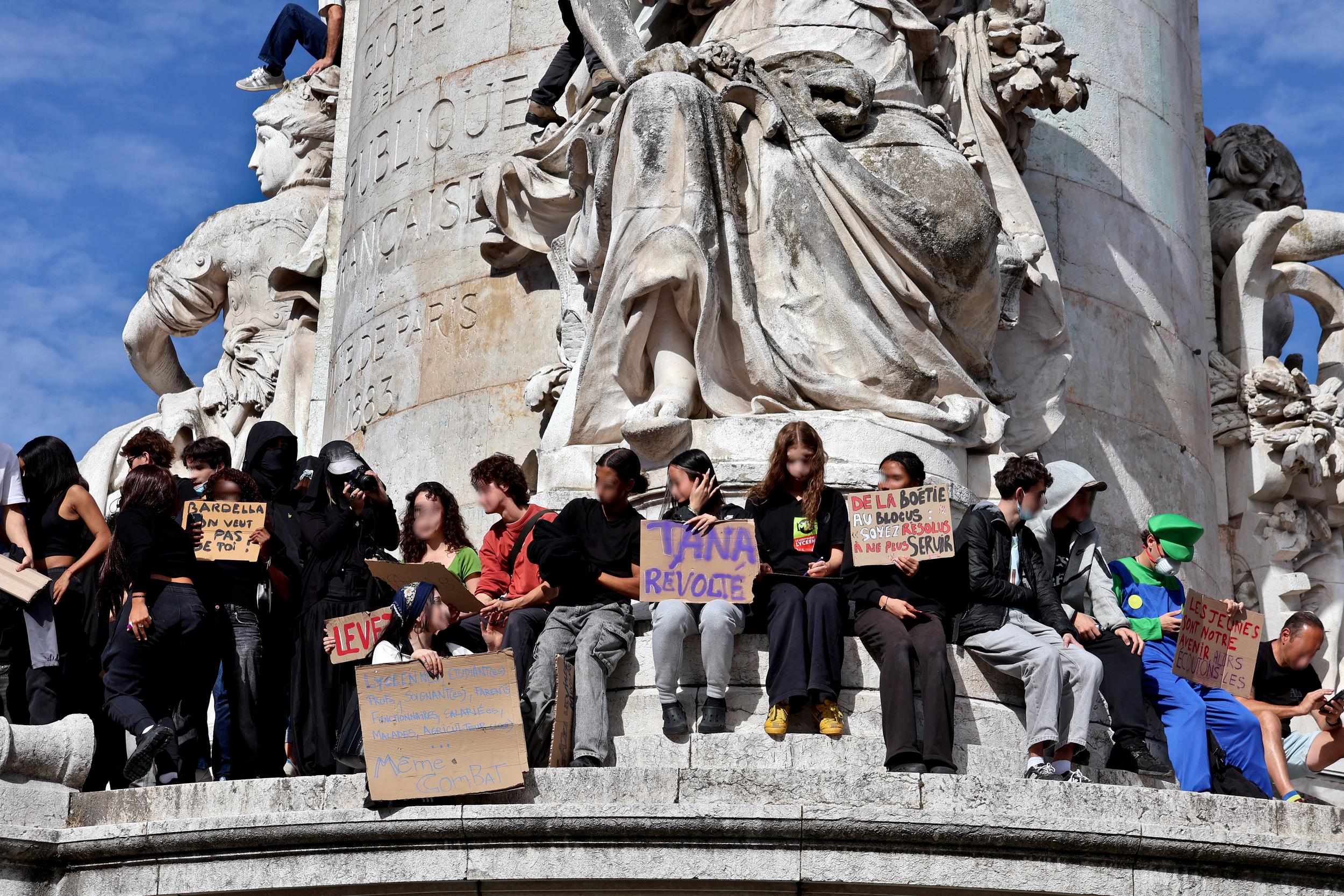
Over the last month, French youth have rocked the country with the biggest student protests in decades. The demonstrations began in a Paris suburb, sparked by students’ frustration over school staffing shortages and poor conditions, but have since spread nationwide and destabilized the government ahead of next year’s presidential election. French police have responded with an unusually heavy-handed approach, arresting over 6,000 people.
France’s student protests are a part of a global pattern in recent years, with numerous high-profile youth movements, including in India and Brazil this year, taking to the streets to demand that their governments address their demands and grievances.
In this edition of “Why It Matters,” the Alliance’s Abby Finkenauer, the former U.S. special envoy for Global Youth, discusses how these protests started, how they’re similar to other youth protests we’ve seen in recent years, and how governments can give young people a more meaningful say on policy choices.
What sparked these protests, and how have French authorities responded?
Finkenauer: What began as students seeking better classroom conditions has now grown into a generation of young people questioning whether their government is paying attention. Although the demonstrations started in a suburb of Paris, they quickly spread across France, with young people voicing broader dissatisfaction with inequality, economic insecurity, and their prospects for the future.
What is particularly worrying, though, is the speed at which the protests have turned into often violent clashes between young people and the police. The French authorities have sent in riot police, resorted to using tear gas, and arrested thousands of demonstrators, among them a large number of teenagers. Such events have raised serious concerns about protecting children's rights and the basic right to peaceful assembly.
The government has announced several measures to address educational concerns and has held talks with student representatives, but it has also placed a strong emphasis on restoring order.
In my experience working with young people all over the world, I have seen how frustration can easily turn into distrust when governments meet reasonable complaints with force instead of taking the time to engage and listen.
Young people should not have to take to the streets for their concerns to be taken seriously. And when they do exercise their right to peaceful protest, they should not have to fear for their safety.
The question now is whether French leaders will see this as a chance to restore trust or let the gap between young people and their government widen further.
Finkenauer: What we’re witnessing in France is part of a much larger global pattern. Young people are increasingly frustrated with political and economic systems they feel are failing them, and they are organizing to demand something different.
This happened in Kenya in 2024, where young people came together to oppose proposed tax rises and rising economic inequality. In Bangladesh, also in 2024, student protests over government job quotas grew into a nationwide campaign calling for political accountability, which led to the toppling of their autocratic government. Meanwhile, last year in Serbia, students took the lead in demonstrations asking for transparency and accountability after a deadly collapse at a railway station.
This year, Indian youth have posed the most serious challenge to Prime Minister Narendra Modi since he came to power in 2014, with massive protests that started over a scandal involving leaked state examinations but now include demonstrations against a controversial decision to remove 130 million Indians from the country’s voter roll. Meanwhile, Brazilian youth have taken to the streets to push back against the rise of the far right.
Although these movements take place in completely different political situations, they have some important similarities.
First, young people are deeply concerned about their economic futures. Whether it’s access to good education, employment opportunities, or the rising cost of living, many feel the promises made by previous generations are increasingly out of reach.
Second, many feel serious frustration with institutions that seem unwilling or unable to respond. Young people are not simply demanding individual policy changes. They are questioning whether the systems governing their lives are fair, accountable, and responsive.
And third, social media has changed how young people organize, communicate, and build solidarity across borders.
As U.S. special envoy for Global Youth, I met young leaders around the world facing these same challenges. Again and again, I heard the same message: they wanted a real seat at the table, not simply an invitation to listen.
We must also acknowledge that these movements are not the same, and the risks young protesters face differ greatly from one country to another.
But the main point is clear: Young people are not disengaged from democracy. In many places, they are working to make it more responsive, inclusive, and accountable.
Finkenauer: First, governments need to understand that young people don’t want to be treated as an afterthought. They want to be treated as partners.
Too often, youth engagement is reduced to a conference, a photo opportunity, or a listening session where young people share their concerns yet have little influence over what happens next.
Meaningful engagement requires something much more substantial.
Governments should institutionalize youth participation in policymaking, bringing young people into the process from the beginning rather than asking for their feedback after decisions have already been made. That means youth advisory bodies with genuine access to decision-makers, intergenerational dialogues, opportunities to shape budgets and legislation, and clear accountability for how their recommendations are considered.
It also means acknowledging that young people are not a single, uniform group; governments should deliberately include those too often left out of political processes, especially young women, youth from rural areas and marginalized communities, and people facing economic obstacles.
Above all, governments must safeguard the basic rights that enable young people to take part in civic life, such as the right to free expression, the right to peaceful assembly, and the right to associate with different groups and political parties. If a government treats young people exercising these rights as a threat, it cannot genuinely value youth participation.
I have personally witnessed the remarkable creativity, courage, and leadership young people display as they try to tackle some of the world's most difficult problems. What they usually lacked was access to the institutions that decide their futures; they didn't lack ideas or determination.
This also offers an important lesson for U.S. foreign policy. Young people are shaping political and economic developments around the world, and how governments respond to their demands has implications for democracy, stability, and human rights. If the United States wants to be an effective global leader, it cannot treat engaging young people as an afterthought in diplomacy.
It must be a meaningful part of how the United States builds relationships, advances human rights, and works with partners to address shared challenges. That means fully funding and expanding the State Department’s regional youth leadership programs, continuing thoughtful exchanges through the International Visitor Leadership Program, and prioritizing young leaders who are raising their voices and working to shape their communities and countries. It also means investing in sustained youth engagement as a cornerstone of our public diplomacy, listening directly to young people, and ensuring their perspectives inform our foreign policy priorities.
The protests in France should remind governments everywhere that they can't wait for young people to take to the streets before listening. Young people shouldn’t have to fight for a voice in their own future. Governments should be making room for them to help shape it.
© 2025 Alliance for Diplomacy and Justice.